
After the family refused to claim the body of Ainul Ansari alias Tarique, a suspect in the serial bomb blasts in Patna who succumbed to his injuries at a hospital, the railway police has decided perform his last rites in a day or two, police officials said on Monday.

There are many reasons why one joins a terrorist outfit. But to point at one factor as the single most crucial one to the formation and actions of the Indian Mujahideen is a political explanation, not strategic, says Bibhu Prasad Routray

One of the two terror accused arrested in connection with the serial blasts in Patna, in which six people were killed and nearly 100 others injured, is battling for his life at a government hospital in Patna and another was sent to remand by the police, officials said on Tuesday.

A serial blast suspect Arshad Ahmad has been picked up for questioning from a village in Bihar's East Champaran district, police said on Wednesday.

"With a splinter lodged in his brain, the chances of his recovery were very poor. He was unconscious and not responding to medication after admitted to hospital," Arun Kumar, director of the Patna-based Indira Gandhi Institute of Medical Sciences, said.

There is "little chance" of survival of the prime suspect in the Patna serial blasts as he has splinters in his brain, doctors treating him said on Wednesday.

Four suspects have been arrested in connection to the serial blasts that rocked Patna on Sunday. They have been identified as Imtiaz Ansari, Kaleem, Mohammad Ainul and Akthar, according to sources.
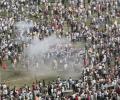
From assembling bombs to planting them, 10 terror operatives spread across Patna on Sunday and wreaked havoc in the city. Vicky Nanjappa reports

In the backdrop of alleged involvement of a 'Ranchi module' of Indian Mujahideen in the October 27 serial blasts near a Bharatiya Janata Party rally in Patna, police on Monday recovered nine live bombs matching those found in Patna from a lodge at Hindpiri in Ranchi.
The National Investigation Agency special court on Tuesday framed charges against 11 accused, all suspected to be members of banned Indian Mujahideen and Students Islamic Movement of India, for the serial blasts at Prime Minister (then Gujarat chief minister) Narendra Modi's 'Hunkar Rally' at Gandhi Maidan in Patna on October 27, 2013.
